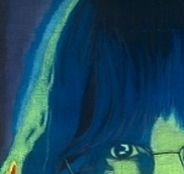
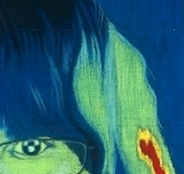
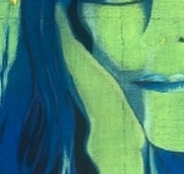
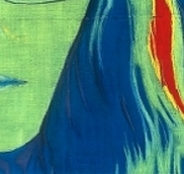
Statements The heart of my work is the human form. Over the past year I have been painting in pastels and with encaustics. The pastels are usually portraits, often oddly cropped and inspired by family photos. The medium of encaustic allows me to layer and collage my monotypes and figure drawings, creating a surface at once rich and luminous. I find that there is no landscape more interesting to me than the body and no terrain more fascinating than the face. In my recent work, I explore a fascination with shadows, using a number of techniques, including printmaking, collage, photography, and painting. First I photograph shadows. Then I make a collage of monotypes to form a single pictoral ground. Onto this ground I stencil and collage more imagery until I've created a surface I like, often a surface designed to resemble a city wall with its rich layers of information and color. Next I arrange some of the photographs of shadows to evoke a kind of story (unknown to me). Sometimes I project these shadows onto butcher paper, cut the paper into stencils, attach the stencils to the surface and paint directly through the stencils to create the finished work. Other times I enlarge and print out manipulated photos of shadows to paste directly onto the surface, which I then paint with encaustics. I find each step of the process compelling, a bit like creating my own shadow plays, in which I serve as director, producer, set designer, and even, on occasion, actor. In 2001 the city of Vicksburg invited artists to submit designs for the city's first public art project, a 57-foot long mural along the downtown seawall. The seawall was built years ago, after the disastrous floods of 1927, to protect Vicksburg from the high waters of the Mississippi River. Directly behind the wall lie the backwaters of the river, and directly in front lie the railroad tracks and the street which runs north to become Highway 61, the famous Blues Highway. These three important arteries of trade, commerce, and flight -- the river, the railroad, the highway -- have had a tremendous impact on the history of Vicksburg, and I wanted to create a design that would celebrate this rich and varied history. Centuries ago, Jewish peddlers fleeing persecution in Europe migrated north from New Orleans to settle in the cities and towns springing up along the river's banks. The railroad provided gainful employment to black men as porters at a time when decent jobs were scarce, particularly for African Americans. These men helped form the backbone of the Brotherhood of Sleeping Car Porters, one of the most powerful and effective unions in the country. Finally, Highway 61, which led straight through the cotton fields of the Mississippi Delta to the big cities in the North, became the chosen route of African Americans migrating out of the South in pursuit of a better life. Times have changed, but river, rail and road activity remain vibrant. I wanted my mural to celebrate the busy, rich diversity of life along the river, from swamplands to catfish farms to pecan groves to cotton fields to casino boats to the harbor project, and to convey something of the dynamic rhythm of life along the Mississippi. The prints in this series were pulled in 2003 with master printer Marina Ancona at Grand Press in Brooklyn, NY. The theme of my mural for the new McWillie School is Motion and Wonder. The school itself is a work of art and of love, a result of collaborative efforts on the part of many diverse members of the community. Their common desire was to provide the children with an environment that would open doors onto a beautiful world of learning and delight. I wanted my mural -- consisting of eight colorful paintings on stainless steel panels, and depicting children running through those doors -- to reflect the joy and wonder of learning which the new McWillie School promises to provide. The Mill Street Viaduct Improvement Project consists of 2 viaducts and a pedestrian market area, three different areas with three different themes. The artwork, 20 panels of fired porcelain enamel on steel, will be placed in openings at the tops of the brick columns supporting the viaducts. Pearl Street leads to Jackson State University, a historically black university which has played a vital role in Jackson's social evolution. I wanted to reference the rich cultural history of the African-American community with images inspired by the Underground Railroad and one of its most courageous conductors, Harriet Tubman. Imagery also refers to the coded freedom song, Follow the Drinking Gourd. The drinking gourd was the Big Dipper, whose handle pointed to the North Star, and the way to freedom. The Capitol Street Viaduct includes the clock tower, and the panels here refer to railroad time. Every station has its clock, every train its timetable, and at one time, every conductor had his pocket watch. Railroad travel marked the beginning of standardized time zones, and the association of trains with time is strong and evocative. Three workers are featured in this area. While the conductor on the south wall of the clock tower checks his watch, we see 2 sets of the Gandy Dancers who laid track and drove steel to maintain the railroads. Throughout the South the Gandy Dancers, mostly African-American, worked in crews, and used the rhythms of motion and song to lighten their backbreaking labor. During World War II, many men's jobs on the railroad were open to women for the first time, and they handled the hard work with skill and strength.
"For Martha Ferris, the human form becomes the basis for a symbolic language. It appears as shadows of bodies in animated movement, silhouettes of figures based on photographs, and in sketches of nude figures. Her canvases are also marked by an array of such forms as directional arrows, decorative patterns, and letters. Gridlike patterns of repeating forms and collaged layers in these compositions suggest the unfolding narrative of a dream or, alternately, the construction of a private visual language that allows the artist to express a range of narratives and emotions." Elizabeth Ferrer, Guest Curator, 2005 Mississippi Invitational "That's the great thing about "Blues Boxes," artist Martha Ferris' marvelous exhibit of layered glass shadow boxes in...the Sylvia Schmidt Gallery: she doesn't use the predictable formulas...Ferris' work is not just smart and beautiful, it proves that artists needn't stick to the tired formulas when depicting pop music themes." Doug MacCash, Art Critic, Times Picayune, May 17, 2002 "The finished mural (McWillie School Mural, Jackson, MS) is spectacular, evocative, mysterious, harmonious, and compelling." Jeff Barnes, Architect and Project Manager for Dale and Associates, and Steering Committee Member for the Arts Installation Program, Jackson, MS, April 11, 2003
|